One photo cannot tell you whether a programme is working. Neither can the soreness after a single workout or an app-generated score in isolation. A better progress record combines what you can do, how consistently you train and, if useful to you, comparable photos or measurements.
The aim is to make decisions with a little more context. You do not need to turn your body into a daily project or collect every possible number.
Use three kinds of evidence
Start with attendance, exercise performance and recovery. Did you complete the sessions you planned? Can you perform the same movement with more control, more repetitions or a suitable increase in load? Are you ready to train again when the next session arrives?
Photos and measurements can add another perspective, but they should not override all the other information. A month of improving training records should not be dismissed because one photograph has unflattering lighting.
Swipe the table to see all columns →
| Measure | A useful comparison | A common trap |
|---|---|---|
| Workout attendance | Planned sessions versus completed sessions | Judging only the hardest workout |
| Exercise performance | Same variation, setup, range and effort target | Comparing unrelated machines or variations |
| Optional photos | Similar lighting, clothing, pose and camera position | Comparing a posed pump photo with a relaxed photo |
| Optional measurements | Same method, location and conditions | Treating a tiny single reading as a meaningful change |
| Recovery notes | Trends in readiness and tolerable workload | Using soreness as the main success metric |
Make the workout log your main tool
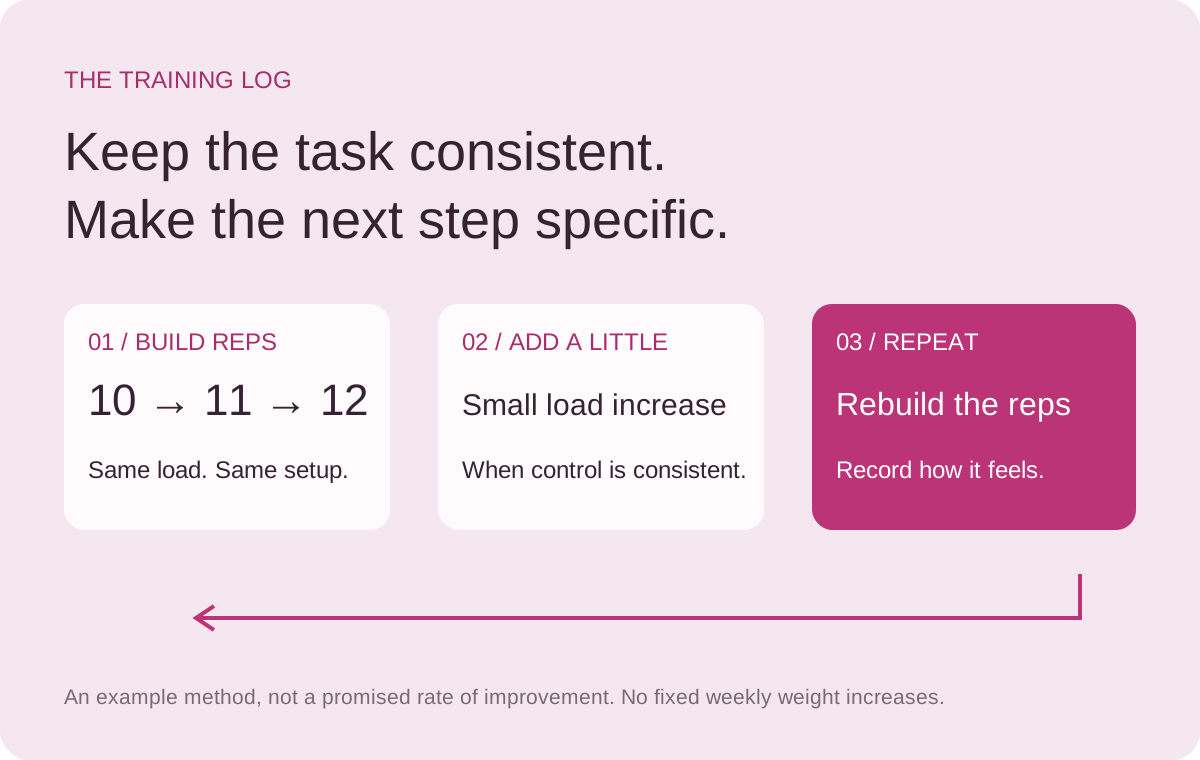
Record enough detail to repeat the task. Include the exercise, load, repetitions and any setup note that affects the movement. A supported split squat should be compared with another supported split squat, not with an unsupported version performed when you were tired.
Over time, look for several movements improving rather than requiring every number to rise each week. A change in exercise order, a stressful week or a new technical standard can alter the comparison. Write a short note rather than forcing an interpretation from the numbers alone.
Read progressive overload for glutes if your log has become a collection of weights without a rule for what happens next.
If you use photos, standardise the conditions
Choose a consistent camera height, distance and angle. Use similar lighting and clothing, and keep the pose as repeatable as possible. A fixed place to stand and a stable phone support can help.
Do not compare a close wide-angle image with a more distant image taken at another focal length. Do not interpret a post-workout pump, a different pelvic position or a change in clothing compression as a direct measurement of growth. If you deliberately change the pose, label it as a different comparison.
You do not need to take photos frequently. Choose an interval that gives you a useful record without encouraging repeated checking. It is also completely reasonable to track training progress without photographing your body.
What a photo-based rating can and cannot show
A photo-based rating is an estimate generated from visible image information. It is not a scan of the underlying muscle, a body-fat measurement or a medical assessment. Pose, lighting, camera angle and clothing can affect what the system can infer.
Within Glutely, use saved ratings as a way to revisit an assessment alongside its photo. Do not treat a few points of difference between images as proof of a precise biological change. A higher score is not a requirement for your training to be worthwhile.
Research that measures muscle changes may use tools such as ultrasound or MRI. The hip-thrust and squat training comparison discusses one example of training research; an app photograph should not be presented as equivalent to those measurement methods.
If you use a tape measure
Choose a repeatable measurement method and record how you performed it. Keep the tape level and avoid pulling it tighter on one occasion than another. Take care not to turn small measurement noise into a confident conclusion.
A circumference measurement reflects more than one tissue and cannot tell you exactly how much muscle changed. Body weight and how clothing fits can add context, but neither isolates glute muscle growth. Use trends, not a single reading.
Review on a schedule that gives you perspective
A brief weekly review can focus on attendance, exercise progression and recovery. A less frequent appearance review can focus on genuinely comparable photos or measurements. Separating those reviews helps prevent an ordinary bad gym day from becoming a verdict on your body.
Ask three questions: what became easier, what is still difficult, and what single adjustment would make next week more workable? The answer may be a smaller load increase, a more convenient training day or enough time to rest between sets.
When progress appears to stall
First inspect the record. Are the sessions consistent enough to compare? Are the exercises still challenging? Has the range of motion changed? Are you eating and recovering in a way that supports the work?
If the programme is new, more practice may be the appropriate response. If you have several weeks of comparable records without improvement, consider a small training adjustment rather than replacing every movement. The frequency guide can help you decide whether the workload needs distributing differently.
Do not use a plateau as a reason to adopt extreme dietary restriction or to double your training abruptly. Changes should solve a specific problem you can describe.
Keep your progress record private by choice
You do not owe anybody a before-and-after photo. If you store body images, use an account and device you trust, understand where the images are held and choose carefully before sharing them. Crop out identifying details when they are unnecessary for the comparison.
Keep a copy of any record that matters to you. Browser storage can be cleared, and different domains or browser contexts can have separate local records. Read Glutely's privacy information before deciding which features to use.
Research and further reading
The tracking checklist here is a practical standardisation method, not a validated method for measuring muscle volume from a smartphone picture. For the distinction between performance and appearance, see how to build glutes. For exercise-study context, see the direct hip-thrust and squat comparison. For product and evidence boundaries, read our editorial policy.
Put it into practice
Give your next workout a plan.
Get started with Glutely for workouts, exercise demonstrations and a place to organise your training. Explore the app and review the available membership options before choosing a plan.
Get started with Glutely