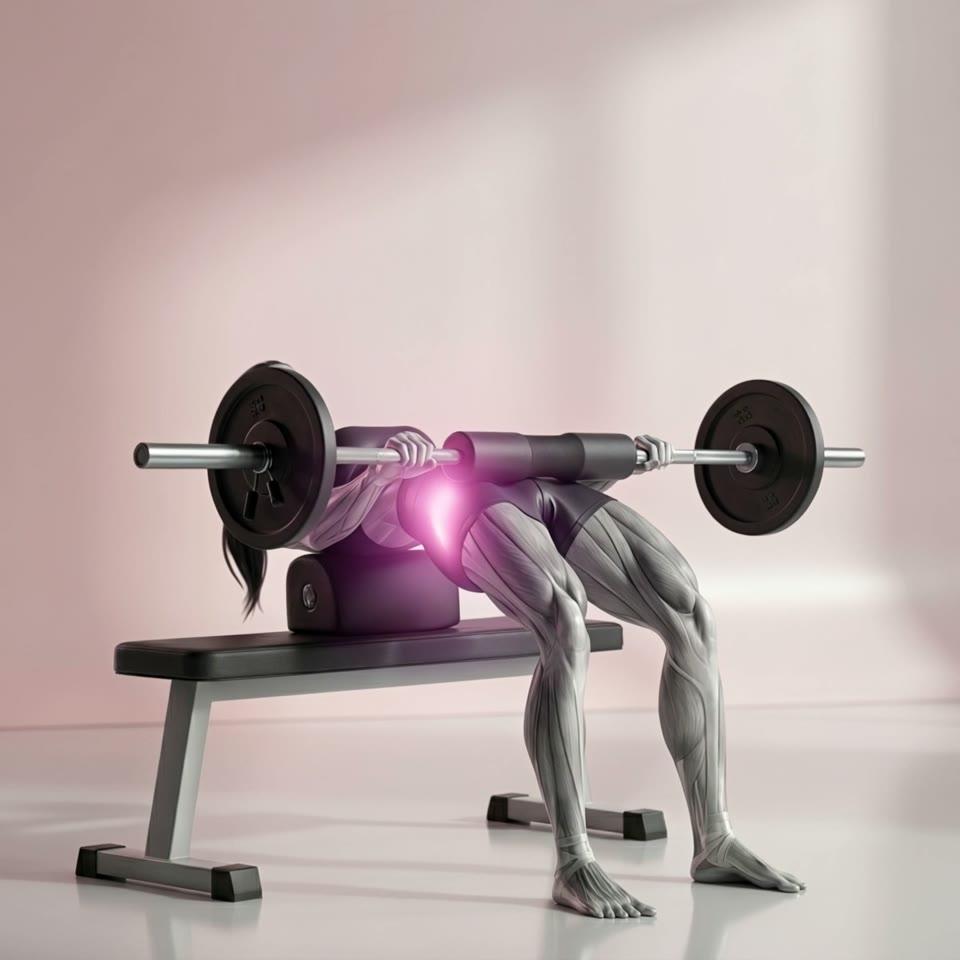
You do not have to crown either the hip thrust or the squat the single best glute exercise. Both can be useful, but they ask different things of your setup, technique and overall session. The better choice is the one that fits your goals and lets you train consistently with appropriate effort.
A comparison becomes more useful when it moves beyond which exercise produces the strongest burning sensation. Look at what you want to train, what equipment you can use reliably and what other exercises already fill your week.
What the two movements involve
In a hip thrust, the upper back is usually supported on a stable bench while you extend the hips against resistance. The setup can let you challenge hip extension without using the same standing squat pattern. Comfortable bench height, padding and load placement matter.
In a squat, you bend and extend the knees and hips while supporting the load. The exercise involves the thighs as well as the glutes, and the available variation, range and resistance depend on your equipment and experience. A goblet squat, back squat and machine squat should not be treated as identical tests.
Neither movement needs to be forced into a shape that your current control or comfort cannot support. Pick an appropriate variation and develop it gradually.
What a direct study found
A 2023 comparison of hip-thrust and back-squat training reported similar gluteal hypertrophy between its groups, with greater thigh hypertrophy in the squat group. Strength improvements favoured the exercise each group practised.
That is useful evidence against a universal winner. It is still one training study with a particular participant group and protocol. It does not prove that every hip-thrust variation and squat variation produce identical results in every person.
Exercise activation readings also should not be treated as a direct ranking of long-term muscle growth. A movement can feel intense or show a strong electrical signal without that alone telling you how much muscle you will gain over a training block.
Choose by your actual constraint
Swipe the table to see all columns →
| If this is your priority | A practical starting choice | What to check |
|---|---|---|
| A glute-focused exercise alongside other leg work | Hip thrust or bridge | Stable support, comfortable load placement |
| Training thighs and glutes in one standing pattern | A suitable squat variation | Repeatable depth, manageable setup |
| Limited home equipment | Floor bridge and a supported split squat | Safe loading and room to progress |
| One movement is uncomfortable | Another tolerable variation | Do not train through pain to follow a ranking |
This table is a decision aid, not a rule that a goal belongs to only one exercise. You can use both, either, or other suitable movements in a coherent plan.
How to combine them without doubling everything
If your programme already contains several demanding squat or lunge patterns, adding a hip thrust may give you a different way to organise hip-extension work. If you only perform bridges and thrusts, a suitable squat or single-leg movement may broaden the training pattern.
The mistake is adding a complete new exercise menu without accounting for the work you already do. Start by replacing or redistributing a few sets. For example, use a thrust in one session and a squat pattern in another, while keeping the total week manageable.
For a beginner, the two-day routine shows how a small movement menu can work without requiring every popular exercise.
Hip-thrust technique priorities
Use a bench or support that will not move. Position the upper back comfortably and get the resistance into place without twisting under a heavy load. Begin with a lighter setup that lets you practise this process.
Drive through the feet and extend the hips to a controlled top position. Stop before extra height comes mainly from arching the lower back. Lower under control and use roughly the same range on each repetition. Foot position can be adjusted for comfort; a single photographed shin angle is not a universal prescription.
If the setup is more demanding than the exercise, a floor glute bridge is a reasonable alternative. See the hip-thrust technique guide for the demonstration and troubleshooting notes.
Squat-pattern technique priorities
Choose a load and variation that let you stay balanced and controlled. Descend through a comfortable range you can repeat, keeping the whole foot supported rather than shifting unpredictably between the toes and heels.
Do not chase a particular depth by losing control of the movement. Equally, avoid adding load while the range shrinks unnoticed. Record the variation and use a consistent standard so that progress means something.
If balance, equipment or confidence makes a bilateral squat difficult, a supported split squat can be a practical option to learn. It remains a distinct exercise and should have its own progression record.
How to compare your own progress fairly
Choose a block of several weeks in which you keep the core exercise menu stable. Track attendance, working-set performance, comfort and recovery. Optional photos can add context, but do not compare a flexed post-workout photo with an unrelated relaxed image and attribute the difference to the exercise.
Do not run a one-week contest based on soreness. A new movement often creates unfamiliar fatigue. That tells you it was unfamiliar, not that it will produce more growth than the exercise you already know.
Questions that come up often
Should I always do the hip thrust first?
Prioritise the movement you most want to perform well while you are fresh. If learning a demanding squat variation is your main objective, it may belong first. If a thrust is the central exercise in a glute-focused session, place it early and organise the rest around it.
What if neither movement works for me?
There are other ways to train, including bridges, hinges and supported single-leg exercises. Persistent pain is a reason to seek individual assessment, not a reason to keep searching for a more forceful cue online.
Research and further reading
- Plotkin and colleagues, 2023: the direct training comparison discussed above.
- Gluteus maximus hypertrophy review, 2025: a broader look at exercise-based interventions.
- Progressive overload: how to improve whichever movements you choose.
Put it into practice
Give your next workout a plan.
Get started with Glutely for workouts, exercise demonstrations and a place to organise your training. Explore the app and review the available membership options before choosing a plan.
Get started with Glutely