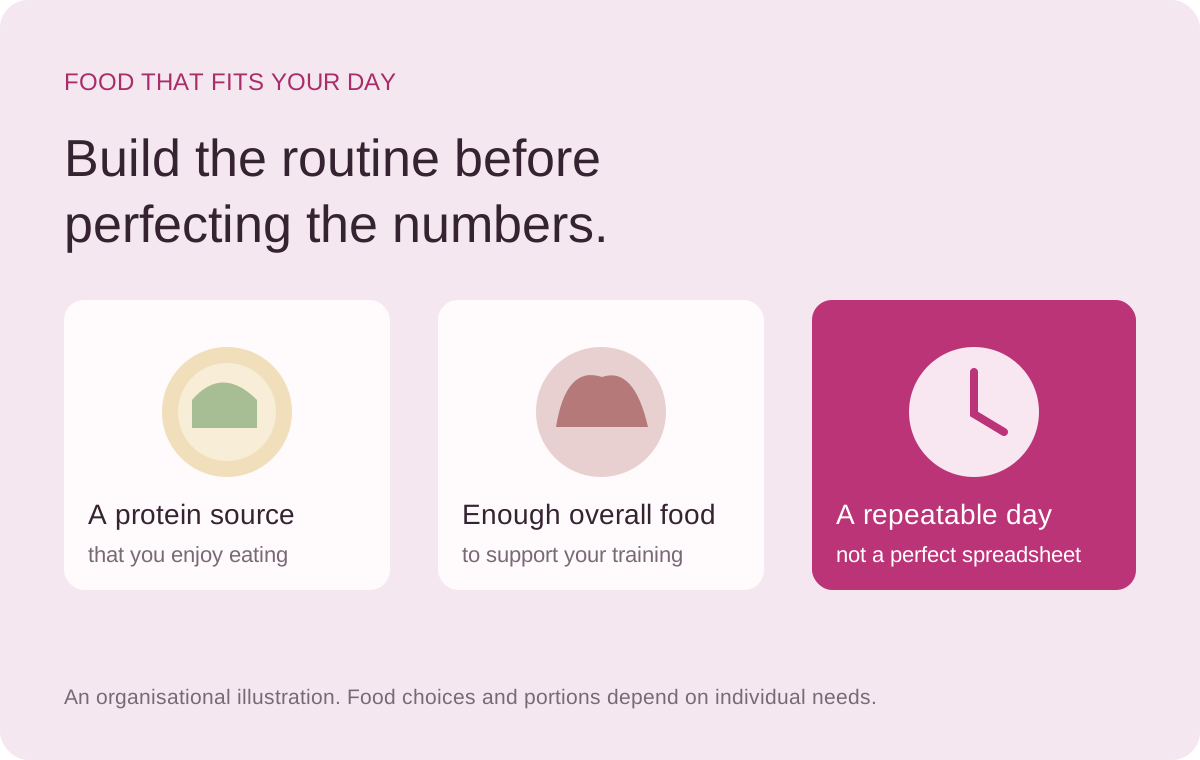
Protein supports muscle building, but there is no food that directs growth specifically to your glutes. Your training provides the local stimulus; food supports the wider process of recovery and adaptation. A helpful nutrition routine therefore begins with regular eating and a realistic protein plan, not a special shake or a dramatic calorie target.
This is general information for adults. It is not a personalised diet, a weight-loss prescription or advice for managing a medical condition. If you have a condition that affects protein needs or food choices, get individual guidance from an appropriately qualified clinician or dietitian.
How much protein is a useful starting point?
The NIH Office of Dietary Supplements describes protein intakes of roughly 1.2–2.0 grams per kilogram of body weight per day in the context of athletes. Your appropriate intake depends on factors including training, overall food intake and personal circumstances.
For a generally healthy adult doing resistance training, around 1.6 g/kg/day is a commonly used planning reference. A large protein-supplementation meta-analysis found an estimated point around that intake beyond which further supplementation did not produce additional average fat-free-mass gains in its analysis. That is an estimate from research, not an exact personal threshold.
For illustration, 60 kg multiplied by 1.6 gives 96 grams per day. You do not need to treat 95 grams as a failed day and 96 grams as a successful one. Use a workable range and an eating pattern you can sustain.
Build meals before buying supplements
Look at the meals you already eat. Identify which contain a meaningful protein source and which are mostly missing one. Adding yoghurt, tofu, beans, eggs, fish, poultry or another suitable food to an ordinary meal may solve the practical problem more easily than adding another rule.
Swipe the table to see all columns →
| Meal situation | Possible protein addition | What to check |
|---|---|---|
| Breakfast is mostly toast or cereal | Eggs, yoghurt or a suitable soy alternative | Portion size and the product label |
| Lunch is mostly vegetables and grains | Beans, lentils, tofu, fish or poultry | Enough food overall, not only protein |
| Dinner already has a protein source | A consistent portion of that food | Whether you enjoy and can repeat it |
| A busy day makes meals difficult | A convenient snack or protein drink | Convenience rather than a compulsory supplement |
Food composition varies by product and preparation. These are options, not claims that every portion supplies the same number of grams. Check labels or a reliable food-composition source when you want a closer estimate.
Spread the plan across your actual day
A daily target is easier to manage when it does not all depend on dinner. If you eat three main meals, include a protein source at each and use a snack if needed. If your schedule uses a different meal pattern, work with that pattern instead of forcing a new one for the sake of a spreadsheet.
You do not need to panic about a narrow post-workout window. Make the next ordinary meal or snack practical, especially if training takes place between work and travel. A food routine that works on busy days matters more than a timing rule you regularly miss.
Do you need more calories to grow glutes?
Muscle building requires resources, but the appropriate energy intake is individual. Training experience, body composition, activity and goals affect the decision. A blanket instruction to eat hundreds of extra calories is not a personalised assessment.
If you regularly skip meals, feel under-fuelled during training or struggle to recover, first address the consistency of your food intake. If your goal includes changing body weight, look at a trend over time and seek qualified support when the right approach is unclear.
An aggressive diet and an ambitious muscle-building programme can create competing practical demands. Do not interpret poor gym performance automatically as a need for more supplements; review whether you are eating enough overall and recovering adequately.
Carbohydrates and fats still belong in the plan
Protein is not the only useful nutrient. Include a variety of foods that provide carbohydrates, fats, fibre and micronutrients alongside your protein sources. A meal can be appropriate even if it does not produce a perfect-looking ratio of macro percentages.
Think about what makes the next workout manageable: a meal you digest comfortably, enough fluid, and a schedule that does not leave you training after a long unplanned gap without food. Individual preferences and tolerances differ, so use your experience rather than copying somebody else's exact meal timing.
How to use a food log without false precision
Use a nutrition log to notice patterns: missed meals, inconsistent portions or days where protein sources are absent. You do not need to assume every entry is an exact laboratory measurement.
Photo-based meal estimates are especially uncertain. Ingredients, oils, portion depth and food hidden underneath are difficult to infer from one picture. In Glutely, review and edit estimated meal details when you know more than the photo can show. A useful estimate should help you organise your eating, not make you distrust your own knowledge of the meal.
If logging food becomes distressing or overly restrictive, step back from the numbers and seek suitable support. The purpose is a routine that supports your life and training.
A week-one nutrition task
For a few ordinary days, write down your meals without trying to optimise everything. Identify one meal where a convenient protein source would help. Make that change, keep it manageable and review how it fits your appetite, budget and routine.
Once that becomes easy, improve another part of the day. This approach is less dramatic than a strict meal plan but gives you something you can repeat when motivation changes.
Common questions
Are protein shakes necessary?
No. They can be convenient when food options are limited, but they are not required for a useful protein intake. Product quality, dietary preferences and individual circumstances still matter.
Can plant-based eating support resistance training?
It can be organised around suitable protein foods and enough overall food. Planning may require attention to portions, variety and specific nutritional needs. A qualified dietitian can help if you are unsure how to put the diet together.
Research and further reading
- NIH: dietary supplements for exercise and athletic performance: broader context on sports nutrition and supplements.
- Morton and colleagues, 2018: protein supplementation and resistance-training adaptations.
- How to build glutes: connect the food routine to a training plan you can actually progress.
Put it into practice
Give your next workout a plan.
Get started with Glutely for workouts, exercise demonstrations and a place to organise your training. Explore the app and review the available membership options before choosing a plan.
Get started with Glutely