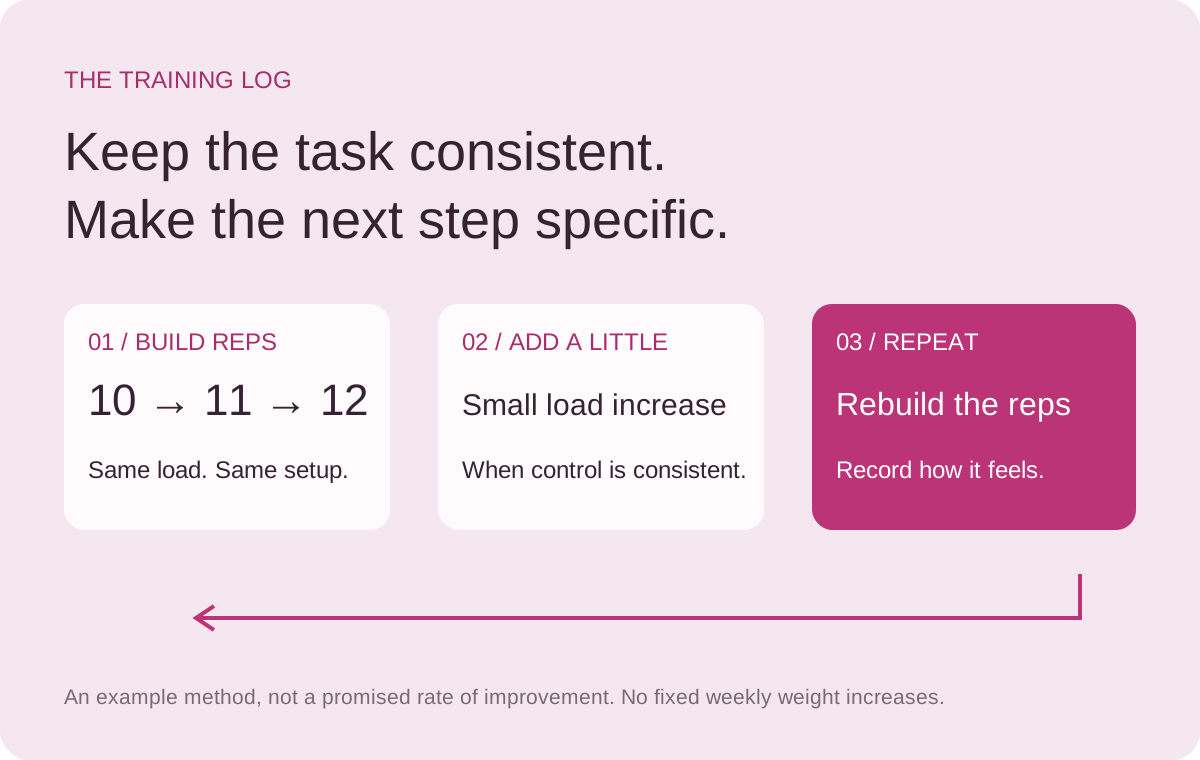
Progressive overload means increasing the demand of training as your capacity improves. For glute workouts, that might mean more controlled repetitions with the same weight, a small increase in load, or eventually an appropriate increase in working sets. It does not mean that every workout must be heavier than the last.
The most useful progression system is one you can apply while keeping the exercise recognisable. If you cannot tell whether you improved or simply changed the task, your log cannot guide the next session.
Start by standardising the exercise
Record the variation, equipment and setup. A floor bridge and a bench-supported hip thrust are different exercises. A machine's labelled weight may not compare directly with another machine. Holding a support during a split squat changes the balance requirement and should be noted.
Choose a comfortable range of motion you can reproduce. Film a brief set for your own reference if that helps, but do not use a camera angle as a substitute for learning how the movement feels. If your range gets shorter each time the weight increases, return to a load that lets you perform the intended task.
Use a rep range instead of one compulsory number
A plan that says two sets of 8–12 repetitions gives you room to progress. Use a weight that allows controlled repetitions within that range while leaving the intended margin before failure. Keep the weight until both sets reach the upper end with the same control and effort target.
Then try the smallest practical increase. You will usually complete fewer repetitions at the new weight. That is expected. The purpose is to rebuild your repetitions under a slightly greater demand, not to match every old number immediately.
Swipe the table to see all columns →
| Session | Hip-thrust load, illustrative only | Working-set reps | Decision |
|---|---|---|---|
| 1 | 30 kg total | 10, 9 | Keep the load and practise |
| 2 | 30 kg total | 11, 10 | Keep building repetitions |
| 3 | 30 kg total | 12, 12 | Consider the next small increase |
| 4 | 32.5 kg total | 10, 9 | Rebuild within the range |
These numbers demonstrate a method, not a recommended starting weight or a promised timeline. Your training may progress more slowly, and the same load may be challenging for longer.
What repetitions in reserve means
Repetitions in reserve is an estimate of how many more repetitions you could complete before reaching your limit with the intended technique. Two reps in reserve means you think about two good repetitions remain, not that you could force two more by bouncing or changing the movement.
The estimate takes practice. Beginners can use a conservative margin and focus on recognising consistent technique. You do not need to perform a risky failed repetition to prove that your estimate was accurate.
A 2024 analysis of proximity to failure examines how this variable relates to training outcomes. It should not be read as an instruction to take every exercise and every set to failure.
When the next dumbbell is too heavy
Some equipment has large jumps. Moving from an 8 kg dumbbell to a 10 kg dumbbell is a bigger relative change than adding a small plate to a heavily loaded bar. If the jump pushes you below your rep range or changes technique, stay at the current weight and build a little more capacity first.
Where equipment allows it, smaller increments can help. You can also choose a slightly wider rep range for an exercise. Another option is to use the heavier weight for one controlled set, then the previous weight for the remaining sets, recording the distinction clearly.
Do not make several changes at once just to feel progress. Adding weight, slowing every repetition and shortening rest simultaneously makes the next session difficult to interpret.
When to add a set
More sets are a possible tool, not the automatic answer to a flat week. First ask whether you have completed the current work consistently, whether the sets are challenging enough and whether you recover before the next session.
If those conditions are in place and progress has stalled for a meaningful run of sessions, try adding one set to a suitable exercise. Keep everything else steady and review how the extra work affects both that session and the next one. If performance declines or attendance becomes harder, the added work may not be useful.
Adding a set is particularly unhelpful when the existing sets are inconsistent or excessively easy. Fix the quality of the task before increasing the quantity.
Why one worse workout is not a plateau
Sleep, stress, meals, menstrual symptoms, travel and other activity can all affect a session. Record a short note and continue the plan. You do not need to replace every exercise because one workout felt unusually hard.
A more meaningful plateau is a pattern across comparable sessions. Before changing the programme, check whether your rest periods, setup, exercise order and effort target have drifted. Sometimes the issue is a different task rather than a stalled adaptation.
Progress you can make before adding weight
Better control, a comfortable and repeatable range, less reliance on momentum and a more consistent setup are useful achievements. They are especially important when learning a Romanian deadlift or split squat.
Write those changes down. If a technical improvement makes an exercise temporarily harder, a lower rep count does not necessarily mean you went backwards. You have created a more honest baseline for future comparisons.
A five-minute weekly review
Look at the previous week's sessions. Circle the movements where repetitions or load improved without a technique change. Mark any recurring discomfort, fatigue or setup problem. Decide on one adjustment for the coming week rather than rewriting the entire plan.
Glutely can give you a place to organise the workout and return to the exercises. The useful habit is still yours: record what happened and use that record to make a specific next decision.
Research and further reading
- ACSM resistance-training overview, 2026: evidence context for progressive training.
- Proximity-to-failure meta-regressions, 2024: interpreting effort without making failure compulsory.
- Track progress with more than a photo and choose a recoverable training frequency.
Put it into practice
Give your next workout a plan.
Get started with Glutely for workouts, exercise demonstrations and a place to organise your training. Explore the app and review the available membership options before choosing a plan.
Get started with Glutely