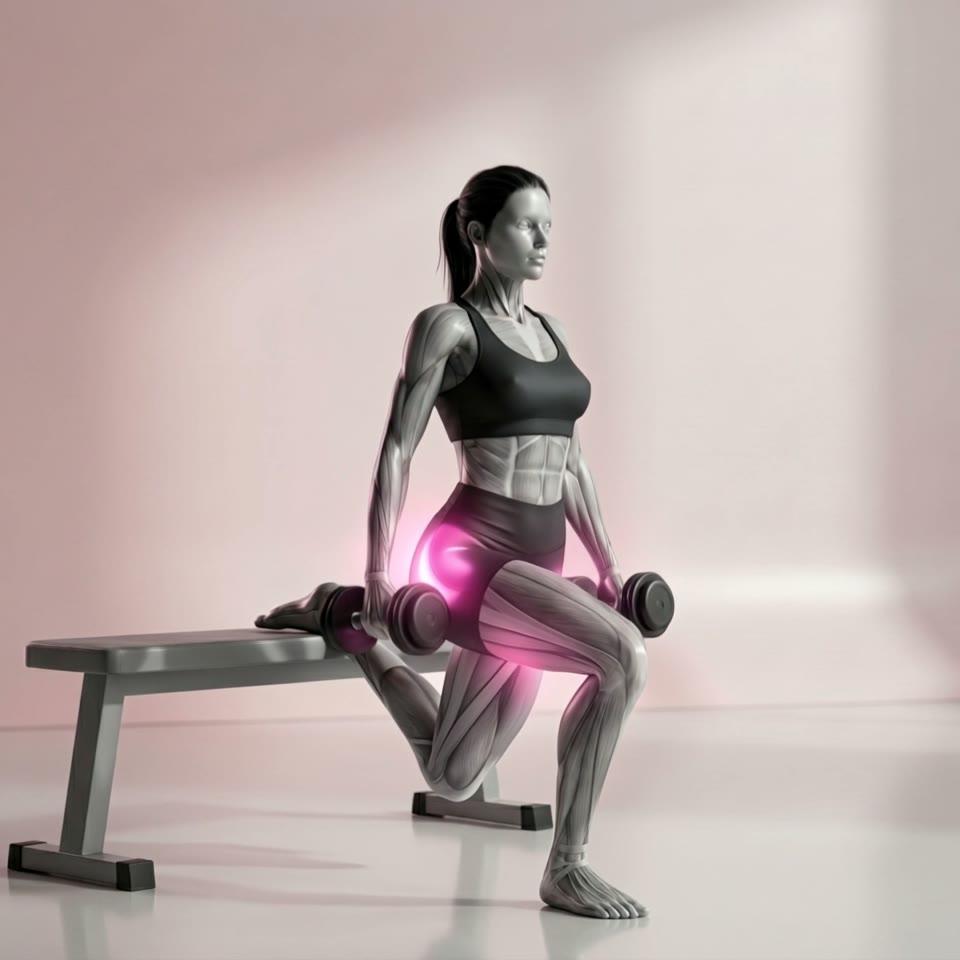
A beginner glute workout should leave you knowing what to do next time. That means a short exercise list, a manageable number of working sets, and a simple rule for progression. You do not need a long activation circuit, five different versions of the same movement or a session that leaves you unable to sit down comfortably.
The two-session example below is designed as a starting template for generally healthy adults. It is glute-focused, not a complete full-body programme. Add other muscle groups around it according to your wider goals, available time and recovery.
Before your first session
Choose two days you can usually keep, such as Monday and Thursday. Leave room between them rather than doing both back to back. Check that the bench, weights and support you will use are available and stable. A simpler setup is better than repeatedly waiting for the most popular machine.
Start with loads that let you practise. Your first session is a chance to find starting points, not a strength test. If you cannot control a movement without weight, reduce the range, use support or choose an easier version before loading it.
A warm-up with a purpose
Spend a few minutes walking or cycling if that helps you feel ready, then practise the first exercise with light resistance. For a hip thrust, that might mean a floor bridge followed by one or two easier thrust sets. For a Romanian deadlift, practise the hinge before picking up the working weights.
Warm-up sets should prepare you rather than exhaust you. You do not need to chase a burning sensation before your main work. If a band drill improves your understanding of a movement, use it briefly. If it makes your first working set worse, shorten it.
Session A: thrust and single-leg work
Swipe the table to see all columns →
| Exercise | Working sets | Repetitions | Starting effort |
|---|---|---|---|
| Hip thrust or glute bridge | 2 | 8–12 | Finish with roughly 2–3 controlled reps left |
| Supported split squat | 2 | 8–10 each side | Leave room to keep balance and depth consistent |
| Side-lying or cable hip abduction | 1–2 | 12–20 each side | Controlled movement without swinging |
Rest long enough between working sets to repeat the movement well. As a practical starting point, try around two minutes for the first two exercises and adjust if breathing, grip or balance has not recovered. Smaller isolation movements may need less rest. A timer is useful, but readiness matters more than finishing the session on an arbitrary countdown.
For the hip thrust, stop the upward movement when you have extended the hips comfortably, rather than trying to lift higher by arching the lower back. In the split squat, hold a stable support if balance is distracting you from the exercise. Support is a tool, not a failure.
Session B: hinge and bridge work
Swipe the table to see all columns →
| Exercise | Working sets | Repetitions | Starting effort |
|---|---|---|---|
| Dumbbell Romanian deadlift | 2 | 8–12 | Stop before technique changes |
| Reverse lunge or supported split squat | 2 | 8–10 each side | Smooth, repeatable repetitions |
| Glute bridge | 1–2 | 10–15 | Comfortable hip extension and a controlled lowering |
The Romanian deadlift is a hinge. Let the hips travel back with a small, fairly consistent knee bend. Lower only as far as you can maintain control; the weights do not need to touch the floor. If the movement is unfamiliar, use light dumbbells and practise from a shorter range.
If the second single-leg exercise feels like too much in your first week, do one working set per side or leave it out initially. You can add it once you understand how you recover. The printed table is not a requirement to push through fatigue or pain.
How to choose the starting weight
The right starting load is one that lets you complete the lower end of the rep range with the same movement from beginning to end. The last few repetitions should require attention without turning into a different exercise.
Beginners often find it hard to estimate repetitions in reserve. You do not need to get that estimate perfect. Use it as a reminder to finish before a grinding repetition or a loss of control. Avoid taking unfamiliar loaded exercises to failure just to discover your limit.
If you finish and could easily do another ten repetitions, add a little resistance next time. If you cannot reach the lower end of the range without rushing or compensating, reduce it.
What to write in your workout log
Record the exercise, weight, working-set repetitions and any relevant setup detail. For dumbbells, note whether the weight is per dumbbell or combined. For a split squat, record each side and whether you held a support. For a machine, note the machine or seat setting when it changes the exercise.
An entry such as “hip thrust, 20 kg total, 10 and 9 reps, two reps left, same bench” tells you much more than “good glute day”. The next session has a clear comparison point.
A realistic first-month progression
Week one is for learning. In week two, repeat the same exercises and try to make the setup less awkward. In week three, add one repetition to a set where your technique and effort allow it. In week four, consider the smallest weight increase only on movements that have reached the top of the range across all prescribed sets.
If you increase the weight and lose several repetitions, stay within the range or return to the previous load. Progress does not require adding weight every week. Read the double-progression method before making the plan more complicated.
Substitutions when equipment is busy
A floor bridge can replace a thrust for that day. A supported split squat can replace a reverse lunge. A dumbbell hinge can replace a barbell hinge. Choose the closest practical movement and write down the substitution rather than treating the numbers as directly interchangeable.
If you train at home, use the home workout guide. Do not improvise an unstable bench from furniture that slides, and do not use a weight you cannot get into position safely.
How to know when to change the plan
Keep the programme while you are learning, attending and improving. Change it when your equipment, schedule, comfort or goals change, or when a thoughtful progression adjustment is no longer enough. Novelty by itself is not a reason to replace useful exercises.
If every session feels worse than the previous one, review sleep, other activity, food and the amount of work before adding exercises. More effort is not always the missing ingredient.
Research and further reading
This is an original example routine, not a protocol reproduced from a trial. ACSM's resistance-training position stand provides the broader evidence context. For schedule decisions, read how often to train glutes. For the principles behind the exercise mix, read how to build glutes.
Put it into practice
Give your next workout a plan.
Get started with Glutely for workouts, exercise demonstrations and a place to organise your training. Explore the app and review the available membership options before choosing a plan.
Get started with Glutely