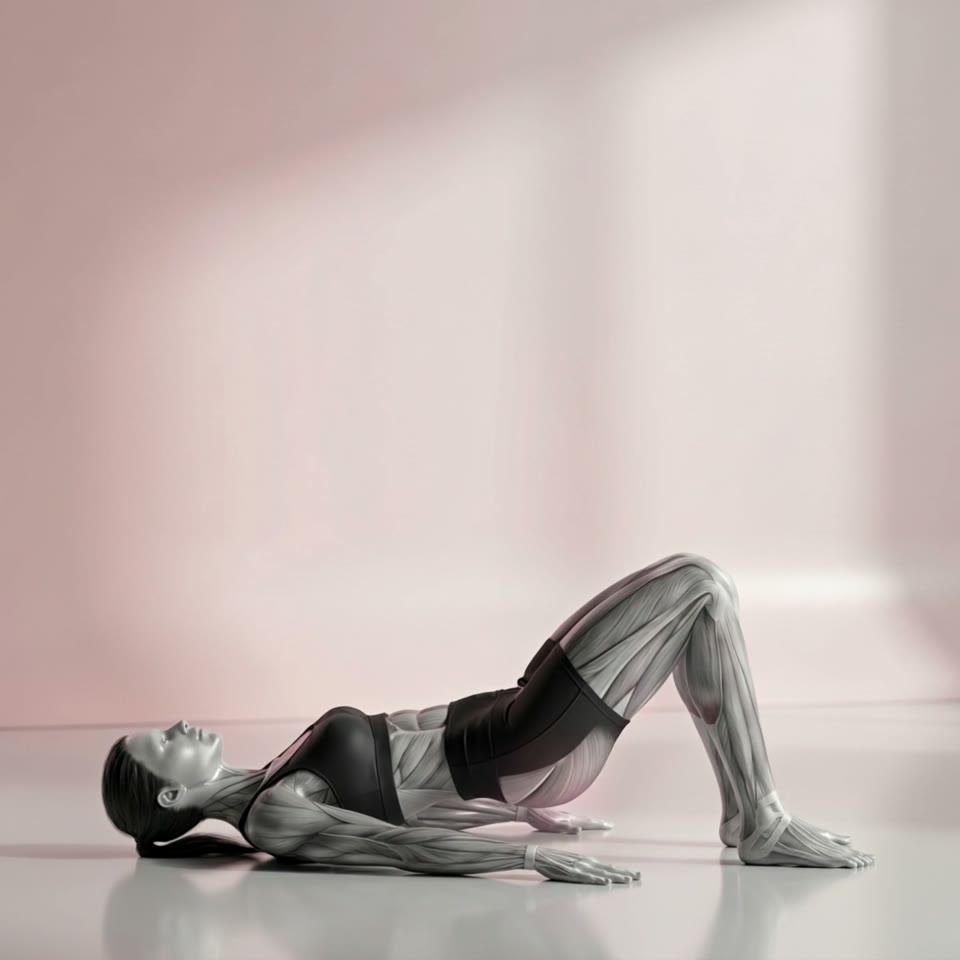
A useful home glute workout is built around the resistance and space you actually have. You can make a session challenging with dumbbells, bands or bodyweight, but each setup has limits. The goal is to choose a few movements you can control and make progressively harder, rather than collecting the longest possible list of exercises.
This guide offers a sample home session and three equipment paths. The suggested sets and repetitions are practical examples for adults, not a claim that one home routine works equally well for everybody.
Check your setup before you start
Clear enough floor space to step back without hitting furniture. Use a surface that does not slide under your feet. Any support used for balance should remain still when you lean on it. If you cannot verify that a bench or sofa is stable, choose a floor-based exercise instead.
Keep weights within reach without leaving them where you will step. Inspect bands for damage and use only secure, manufacturer-approved anchor points. A makeshift anchor that releases towards you is not worth the convenience.
A simple home session
Swipe the table to see all columns →
| Exercise | Starting working sets | Rep range | Equipment |
|---|---|---|---|
| Floor glute bridge | 2 | 10–15 | Bodyweight or one dumbbell |
| Supported split squat | 2 | 8–12 per side | Bodyweight or dumbbells |
| Romanian deadlift | 2 | 8–12 | Dumbbells or a suitable loaded implement |
| Side-lying hip abduction | 1–2 | 12–20 per side | Bodyweight or a band |
Practise each movement with easy resistance first. Leave a few controlled repetitions in reserve while you learn. If this is more work than you can recover from, begin with fewer sets or omit the final movement. If you have no suitable resistance for the hinge, use the equipment-free path below instead of pretending an unloaded movement is automatically equivalent to a loaded deadlift.
Repeat the session on two separated days initially if that suits your wider activity. A home session is still training; doing it in your living room does not remove the need for recovery.
Path one: you have adjustable dumbbells
Dumbbells give you a straightforward way to record and increase resistance. Use them for the Romanian deadlift, hold them at your sides for a split squat, and position one securely across the hips for a glute bridge. A folded pad can improve comfort, but the weight still needs to remain under control.
Record whether you used one or two dumbbells and the weight of each. Two 8 kg dumbbells are not an 8 kg total load. Consistent logging saves confusion when you review the previous session.
When a weight becomes easier, build towards the top of your rep range before taking the next small load increase. If your dumbbells have reached their maximum, a supported single-leg variation may provide a new challenge. Treat it as a new exercise with a new starting point, not as a direct continuation of the old load record.
Path two: you have resistance bands
Bands are convenient, but the resistance changes as they stretch. Record the band, its position and the distance from any secure anchor. Colour alone is not a standard weight measurement across different manufacturers.
A band can make hip abduction harder, but a light loop above the knees does not necessarily make a bridge a demanding hip-extension exercise. Ask what is actually limiting the set. If you can comfortably perform a very large number of bridges, another resistance option may be more useful than adding more band drills.
Avoid moving the band to a more extreme position just to make a repetition feel difficult. You should still be able to control the movement and return to the same starting position.
Path three: you have no equipment
Begin with floor bridges, supported split squats and side-lying abductions. A pause can make you slow down and understand the movement. A single-leg bridge can provide a more challenging variation once the two-leg version is controlled.
Use a comfortable range and stop if balance or joint discomfort becomes the main limiting factor. You do not need to elevate your feet or shoulders simply because a video shows it. An ordinary floor exercise that you can repeat is a better starting point than an unstable variation.
Bodyweight work can become limiting for muscle-building goals. If you are completing controlled repetitions far beyond your planned range without much effort, consider adjustable dumbbells, a gym or another reliable source of load. There is no need to call a bodyweight exercise ineffective; just recognise when it no longer matches the task you want it to do.
Progress without turning every session into a circuit
Rest between working sets so you can repeat the exercise well. Performing every movement continuously may make you breathless before the target muscles receive a useful challenge. A circuit can be enjoyable, but fatigue and progression should still be distinguishable.
Keep most of the session stable for several weeks. Add repetitions first where appropriate, then load or a more demanding variation. Change one variable at a time. If you simultaneously add a band, shorten rest and move to a single-leg version, the next workout has no clean comparison.
The home-workout log
Write the exercise, resistance, repetitions and any support or anchor detail. For a band movement, a quick note or setup photo can help you reproduce the resistance. For a floor bridge, record whether you used one or two legs and whether the load was held across the hips.
If you have a small space or a short time window, remove an accessory before rushing every set. Two well-organised movements can be more practical than four movements squeezed into a session you cannot finish.
Common questions
Do I need a gym to start?
No. Begin with an appropriate home setup and learn the movements. A gym becomes useful when you want equipment, loading options or coaching that your home cannot provide.
Can I train at home every day?
Being able to access the floor every day does not mean hard daily sessions are necessary. Review the frequency guide and leave room for the next session to be productive.
Research and further reading
The sample session is an editorial example. Research on gluteus maximus hypertrophy concerns specific exercises and loading protocols; it does not validate every bodyweight or band variation online. Use progressive overload to assess whether your own setup remains challenging.
Put it into practice
Give your next workout a plan.
Get started with Glutely for workouts, exercise demonstrations and a place to organise your training. Explore the app and review the available membership options before choosing a plan.
Get started with Glutely